It’s a question that has surfaced in every conversation we’ve had about AI this year, in how we talk about agentic systems, in how we measure ROI, in how we think about deployment. Most organisations think they’ve already answered it. They’ve created a Chief AI Officer role, stood up a Centre of Excellence, maybe hired a Head of Responsible AI. The governance slide deck exists. The steering committee has a calendar invite.
And yet, when something goes wrong, when an AI model surfaces a flawed output that shapes a hiring decision, a pricing call, or a customer interaction, the question of who is actually responsible tends to produce a very familiar silence.
The illusion of assigned ownership
In most large enterprises, AI ownership is fragmented across four different conversations that rarely happen in the same room.
- There’s the strategy conversation: who decides where AI gets deployed and what problems it’s meant to solve.
- There’s the governance conversation: who sets the rules, the guardrails, the acceptable use boundaries.
- There’s the budget conversation: who controls AI spend, which vendors get approved, which use cases get funded.
- And there’s the accountability conversation: who is responsible when the output is wrong, the model drifts, or the data feeding it was never fit for purpose.
Each of these conversations is happening. They’re just happening in different parts of the organisation, owned by different functions, often without meaningful coordination. IT holds the infrastructure. Finance holds the budget. Legal holds the risk. Business units hold the use cases. This results in governance without the substance of it.
This is how enterprises end up in a position where AI is running in production, touching real decisions, and nobody can give a clean answer to a simple question: if this goes wrong, who owns it?
The question underneath the question
Here’s what most AI ownership conversations miss: the problem didn’t start with AI.
Organisations that struggle to govern their AI outputs are almost always organisations that never fully resolved data ownership in the first place. The two are inseparable. An AI model is only as reliable as the data it was trained on, queried against, and validated with. If that data has unclear ownership, if nobody is formally accountable for its quality, its lineage, its access permissions, then the AI built on top of it inherits every one of those gaps.
This is the dependency that gets skipped. Businesses see AI as a capability question without recognising that it is, at its foundation, a data question. Who owns this data domain? Who approves access? Who is responsible when the numbers don’t add up?
When those answers don’t exist, AI doesn’t create new problems so much as it amplifies the ones already there. A data quality issue that was tolerable when it lived in a spreadsheet becomes a trust problem when it’s surfaced through an AI prompt to a senior decision-maker. The scale and speed of AI makes previously manageable ambiguity suddenly very expensive.
Where ownership breaks down in practice
The fracture points are predictable, and they show up consistently across large organisations.
- On strategy, AI deployment decisions are often made by business units moving fast, without visibility into what data they’re drawing on or whether that data is governed. The function with the budget moves first; the function with the governance context often finds out later.
- On accountability, the instinct is to point at the technical team, whoever runs the platform, manages the data warehouse, maintains the pipelines. But technical ownership of the infrastructure is not the same as business ownership of the data or the decisions it drives. Conflating the two is one of the most common and costly mistakes enterprises make.
- On governance, the frameworks exist. The policies get written. Without ownership embedded in job descriptions and performance accountability, governance ends up being just a document. People change. Reorganisations happen. If ownership lives with a person rather than a role, it leaves when they do.
- On budget, AI spend is frequently approved without a parallel investment in the data foundations that make AI trustworthy. The tool gets funded. The governance infrastructure does not.
What clarity looks like when you can’t start from scratch
Most large enterprises aren’t in a position to redesign their data ownership model before AI moves forward. The business won’t wait. The board wants results. The use cases are already in flight.
Clarity, in that context, isn’t about achieving a perfect operating model. It’s about knowing who is accountable for the data domains your AI is drawing on, and what happens when something breaks.
That’s a narrower and more achievable question than “who owns AI?” It doesn’t require a restructure or a three-year governance programme. It requires an honest audit of where ownership is genuinely established versus where it’s assumed. In most enterprises, that gap is larger than leadership expects and the AI programme is quietly dependent on the assumed half.
The organisations making progress aren’t necessarily the most mature. They’re the ones that have stopped treating data ownership as a pre-condition they’ll get to eventually, and started treating it as the thing AI deployment is contingent on right now.
The conversation worth having
The theory is one thing. What it looks like in organisations navigating this in real time – the resistance, the workarounds, the moments that forced the issue, is another.
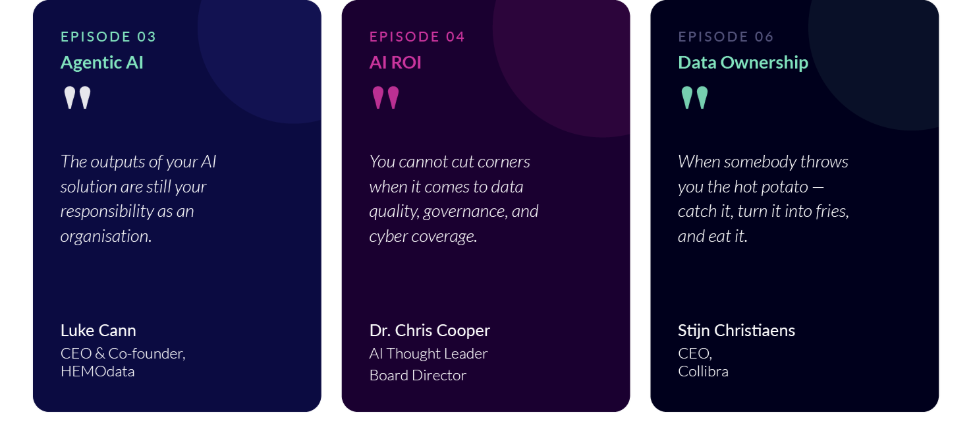
We’re exploring exactly that in an upcoming episode of It’s Data Habibi, with Stijn Christiaens, CEO of Collibra, and Ben Coakley, Data Governance Lead with over two decades of experience across the MENA region. Two practitioners who’ve seen what happens when ownership is clear and when it isn’t. Stay tuned.
Stay up to date with data and AI in the GCC
Get updates on HEMOdata’s latest content, events, and insights delivered to your inbox.