If your organisation handles customer data, employee data, or any personal information at scale, someone in your business has probably already asked this question, usually after a new regulation lands on a compliance team’s desk, or after a data incident somewhere else in the market makes the risk feel less theoretical. The honest answer is almost always yes. The harder question is what “having” one requires.
Most businesses that reach this point already have someone unofficially doing pieces of the job, a legal lead fielding data requests, an IT manager handling access questions, a compliance officer drafting privacy notices when they have time. What they don’t have is a single, accountable function whose entire mandate is protecting how personal data is collected, used, and shared, and who has the standing to say no when a new initiative puts that at risk.
What a Data Protection Officer Actually Does
The role gets reduced, in most people’s minds, to paperwork: privacy policies, consent forms, a breach log nobody updates until something goes wrong. That’s the visible surface, not the substance. A properly functioning data protection function does three things continuously: it monitors how personal data moves through the business as new systems, vendors, and AI use cases get introduced; it advises the business before a decision is made, not after; and it acts as the credible point of contact when a regulator, a customer, or an employee has a question the organisation needs to answer clearly.
Regulators across the region, including Saudi Arabia’s PDPL, Oman’s PDPL and the UAE’s federal and free-zone data protection laws, increasingly expect this function to exist formally, with real independence, rather than being folded into someone’s existing job description.
That expectation isn’t the reason to build the function well. It’s the minimum bar.
Why the In-House Version Often Falls Short
None of this is usually a knowledge gap. Most organisations at this stage have people who understand the requirements reasonably well.
What’s missing is the ability to give one person the independence, the bandwidth, and the cross-functional visibility the role needs, without either overloading someone already stretched across another mandate, or creating a full-time hire whose workload doesn’t justify the cost on its own, particularly for mid-sized organisations where personal data touches several departments but not at the volume of a bank or telco.
Independence is the part that’s easiest to compromise without noticing. A data protection lead who also owns the AI roadmap, or reports into the same function whose practices they’re meant to be scrutinising, is structurally compromised before anything goes wrong. The role only works if the person holding it can push back, and pushing back is hard to do credibly when your other job depends on the initiative going ahead.
The gap tends to surface at the worst possible moment: when a new AI initiative starts processing personal data at a scale nobody scoped for, or when a regulator or customer asks a question the organisation doesn’t have a ready answer to. By then, building the function properly is a much harder conversation than resourcing it from the start.
The Case for a Dedicated External Function
For a risk or compliance team, the real comparison isn’t the cost of an external function against an internal salary line. It’s the cost of finding out, during an actual regulatory inquiry or a serious data incident, that the function meant to have caught this couldn’t, because it was never independent enough, resourced enough, or current enough to do the job it was appointed for.
Independence is the first thing under scrutiny in that scenario, and it’s the hardest thing to manufacture credibly after the fact. A regulator or an external auditor assessing whether an organisation exercised due care will ask who the DPO reports to, whether that person has ever overruled a business decision, and whether the appointment has any documented authority behind it. An internal appointee holding the role alongside another job, especially one with a stake in the initiative being scrutinised, struggles to answer those questions well, not because the person lacks competence, but because the structure was never built to support an honest “yes.”
A dedicated external function resolves this by design. The mandate isn’t shared with another role, so there’s no competing incentive to weigh against a difficult call. The independence is documented and demonstrable from day one, which matters as much to an auditor as it does in the moment a hard decision needs to be made. And because the function operates across multiple organisations rather than inside a single one, it carries pattern recognition an internal appointee can’t build alone, what a regulator has flagged elsewhere, how enforcement is trending, which practices are drawing scrutiny before they show up in an official notice. That’s not a claim any single internal hire, however capable, can make in their first year in the role, or often in several.
There’s also a continuity argument risk teams tend to underweight until it costs them. An internal DPO who leaves, is promoted, or is reassigned creates a coverage gap at precisely the moment institutional knowledge about the organisation’s data practices matters most. A dedicated external function doesn’t carry that single-point-of-failure risk, the mandate, the documentation, and the working knowledge of the organisation persist independent of any one person’s employment status.
None of this makes the function less rigorous than an internal appointment done well. It makes the independence, the continuity, and the evidentiary record easier to stand behind when it’s tested, which, for most organisations, is the point at which it matters most.
The same principle holds here as with any governance function: it fails when it’s treated as a document produced once a year, rather than a capability that runs continuously alongside the business. A data protection lead who only shows up when a form needs signing isn’t meeting the standard the role was built for.
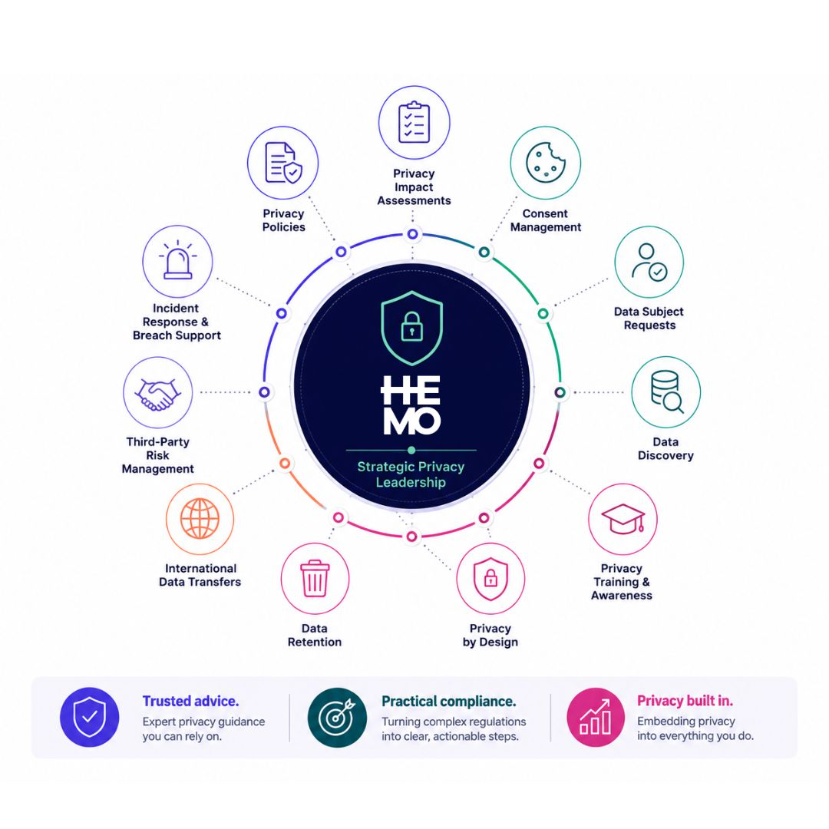
In practice, that means the function has to cover far more ground than a breach log and an annual policy refresh: privacy impact assessments, consent management, data subject requests, international transfers, third-party risk, and incident response all sitting under one accountable mandate.
Where This Fits
If your organisation has someone informally covering this role, or a DPO appointed without the independence or bandwidth to do it properly, that’s the moment to look at how the function is resourced.
HEMOdata’s DPO-as-a-Service model gives GCC organisations exactly this: an independent, fully resourced data protection function without the internal trade-offs. Learn more on our DPO-as-a-Service page →